-
Study
-
Quick Links
- Open Days & Events
- Fixed Block Degrees
- Real-World Learning
- Unlock Your Potential
- Tuition Fees, Funding & Scholarships
- Still Time to Apply
-
Undergraduate
- Application Guides
- UCAS Exhibitions
- Extended Degrees
- School & College Outreach
- Parents & Guardians
-
Postgraduate
- Application Guide
- Postgraduate Research Degrees
- Flexible Learning
- Change Direction
- Register your Interest
-
Student Life
- Students' Union
- The Hub - Student Blog
- Accommodation
- Northumbria Sport
- Support for Students
-
Learning Experience
- Real-World Learning
- Research-enriched learning
- Graduate Futures
- The Business Clinic
- Study Abroad
-
-
International
International
Ideally situated in the 5th best student city in the UK (QS Best Student Cities 2026), Northumbria University is a UK Top 40 University (Complete University Guide 2026) with a diverse community of 34,500 students from over 140 countries.
View our Global Footprint-
International Students
- Information for International Students
- Northumbria and your Country
- International Student Events
- Application Guide
- Entry Requirements and Education Country Agents
- Global Offices and Regional Teams
- English Requirements
- English Language Centre
- International student support
- Cost of Living
-
International Fees and Funding
- International Undergraduate Fees
- International Undergraduate Funding
- International Masters Fees
- International Masters Funding
- International Postgraduate Research Fees
- International Postgraduate Research Funding
- Useful Financial Information
-
International Partners
- Agent and Representatives Network
- Global Partnerships
- Global Community
-
International Mobility
- Study Abroad
- Information for Incoming Exchange Students
-
-
Business
Business
Northumbria University is proud to offer a range of Professional, Statutory and Regulatory Body (PSRB) approved & accredited courses and programmes. Explore our list of courses and programmes under our Education and Training page.
More on our Business Services-
Business Quick Links
- Contact Us
- Business Events
- Research and Consultancy
- Education and Training
- Workforce Development Courses
- Join our mailing list
-
-
Research
Research
Northumbria is a research-rich, business-focused, professional university with a global reputation for academic quality. We conduct ground-breaking research that is responsive to the science & technology, health & well being, economic and social and arts & cultural needs for the communities
Discover more about our Research-
Quick Links
- Research Peaks of Excellence
- Academic Departments
- Research Staff
- Postgraduate Research Studentships
- Research Events
-
Research at Northumbria
- Interdisciplinary Research Themes
- Research Impact
- REF
- Partners and Collaborators
-
Support for Researchers
- Research and Innovation Services Staff
- Researcher Development and Training
- Ethics, Integrity, and Trusted Research
- University Library
- Vice Chancellors Fellows
-
Research Degrees
- Postgraduate Research Overview
- Doctoral Training Partnerships and Centres
- Academic Departments
-
Research Culture
- Research Culture
- Research Culture Action Plan
- Concordats and Commitments
-
-
About Us
-
About Northumbria
- Our Strategy
- Our Staff
- Our Schools
- Place and Partnerships
- Leadership & Governance
- University Services
- Northumbria History
- Contact us
- Online Shop
-
-
Alumni
Alumni
Northumbria University is renowned for the calibre of its business-ready graduates. Our alumni network has over 253,000 graduates based in 178 countries worldwide in a range of sectors, our alumni are making a real impact on the world.
Our Alumni - Work For Us
A team of space weather experts from Northumbria University has been awarded more than £400,000 to explore how to better predict the conditions in near-Earth space.
The environment in the radiation belts 60,000km above the Earth can be highly dangerous – both to human life and to technology such as satellites launched into orbit.
However, the method currently used to predict when and where periods of high radiation might occur are based on average measurements, meaning scientists are unable to accurately forecast particularly dangerous events.
Professor Clare Watt, a space plasma physicist from Northumbria’s Department of Mathematics, Physics and Electrical Engineering, is leading a new project which aims to find a way of forecasting space weather more accurately – something which would have huge economic benefits.
Funded by the Science and Technology Facilities Council (STFC), the project will combine spacecraft observations and samples of the atmosphere at different positions in near-Earth space, with numerical models which use that data to predict dangerous weather conditions.
Speaking about the research, Professor Watt said: “The near-Earth environment is so variable because our Sun is a magnetically variable star affecting both electromagnetic waves and high-energy particles in the area of space close to Earth.
“Understanding the near-Earth environment is a real challenge, but one we need to address, especially given our increasing use of satellites in everyday life and the focus on human space travel.
“Just as predicting storms here on Earth allows us to keep aircraft and passengers safe, predicting storms in space will allow us to ensure astronauts and satellites are protected from severe space weather events.”
Professor Watt will work alongside post-doctoral research associate Dr Oliver Allanson on the three-year Effects of Temporal Variability on Wave-Particle Interactions in Magnetospheric Plasma project.
They will use data collected by NASA’s Van Allen Probes – two robotic spacecraft used to study the Van Allen radiation belts surrounding Earth between 2012 and 2019, measuring electromagnetic waves and energetic electrons.
They will also have access to high performance computing facilities and a state-of-the-art numerical model that will use the data collected to predict interactions between charged particles and the electromagnetic waves.
Professor Watt added: “For much of the time conditions in near earth space are mild, but the rare extreme events that do occur can be very dangerous.
“Because these events are so rare, we need something to help us understand them. Nobody has looked at this in the way we are proposing before – looking at variations in time rather than averages.
“By better understanding the radiation belt environment and its variability we can ensure we are better prepared here on earth. This could change how we design spacecraft and satellites in future, how space exploration missions are planned and how we keep astronauts safe.”
Satellites are an integral part of our life on earth – Global Positioning Systems (GPS) are used for everything from shipping to farming, while satellites also allow us to monitor global pollution, provide us with broadband, TV and mobile phone signal and allow us to predict the weather here on Earth.
Professor Watt and Dr Allanson are both members of Northumbria University’s internationally renowned Solar-Terrestrial Science research group and are involved in several UK-wide space weather research projects.
Professor Watt is part of the research team involved in the SWIMMR (Space Weather Instrumentation, Measurement, Modelling and Risk) project – a £20 million, four-year programme, announced by the Prime Minister Boris Johnson at the UN General Assembly in 2019, that will improve the UK's capabilities for space weather monitoring and prediction.
Professor James McLaughlin leads Northumbria’s Solar-Terrestrial Science research group. Speaking about Professor Watt’s new research he said: “Satellites play a key role in our daily lives, more satellites are being launched regularly by countries around the world, crewed space missions are being planned (first back to the Moon and, within the next 15-20 years, to Mars), and we are at the beginning of an age of space tourism. All of these endeavours will need protection from the natural hazard that is severe space weather, and I am delighted that Professor Clare Watt is leading the way on this project which is of international importance.”
Northumbria University’s Solar-Terrestrial Science research group is part of Unit of Assessment 14 Geographyand Environmental Studies in the Research Excellence Framework (REF) 2021. Find out more about Northumbria University’s REF 2021 submission here.
Department of Mathematics, Physics and Electrical Engineering
This department encompasses all of our work in Mathematics, Statistics and Physics including Astrophysics, Electrical and Electronic Engineering, Energy, Smart Materials, Microelectronics and Communications.

Northumbria has submitted 1096 staff across thirteen Units of Assessment (UoA) to the Research Excellence Framework (REF) 2021. This submission reflects our research across four Faculties and nineteen Departments, incorporating traditional disciplines, such as English and Engineering, modern disciplines, such as Business and Design, and professional disciplines, such as Architecture and Nursing.
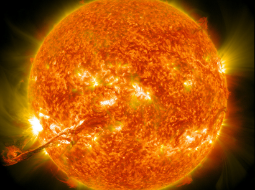
The Solar-Terrestrial Science group has a long-term research programme to investigate how the Sun drives space weather (a term describing a series of phenomena originating from the Sun).

Geography and Environmental Studies investigates the increasingly urgent issues affecting the world and its people such as the climate crisis, global sustainable development, solar-terrestrial science and cold climates.
This is the place to find all the latest news releases, feature articles, expert comment, and video and audio clips from Northumbria University
Latest News and Features
Northumbria researchers win prestigious Academy of Medical Sciences awards to tackle Parkinson's disease and osteoarthritis
Two Northumbria University researchers are among 55 early career scientists across the UK to…
Northumbria University researchers secure major funding to solve space radiation mystery
Researchers at Northumbria University have been awarded £4m to unlock the secrets of Earth's…
Northumbria University appoints new Deputy Vice-Chancellor and Provost
Northumbria University has announced that Professor Andy Dougill will become its new Deputy…
Northumbria University research unlocks the secrets of Vivienne Westwood's craft in a major new exhibition
A fashion researcher and educator from Northumbria University has created what is believed…
NESST topping out ceremony attendees receive traditional tankards to celebrate build milestone
Topping out ceremony marks pivotal moment for centre backed by £50 million investment set to…
From Netflix to Newcastle Northumbria graduate uses AI to revolutionise film and TV production
A Northumbria University graduate who co-created Bangkok Breaking — one of Thailand's biggest…
Northumbria University researcher brings death-positive arts festival to libraries across England
An arts festival exploring death, dying and end-of-life choices — led by a Northumbria University…
Northumbria University spinout achieves CE marking for deep lung breath sampling device — a first backed by peer-reviewed research
A medical device company spun out of Northumbria University has reached a significant milestone…
Upcoming events
Broken Bonds: New Perspectives on Marital Breakdown
The Great Hall
-
Smarter Supply Chains: Digital Innovation for Cost, Efficiency & Carbon
Northumbria University
-
Culture in Conversation: Rethinking Leadership & Organisational Practice
CCE1 Newcastle Business School
-