Human-Computer Interaction MSc
1 Year, Full-Time | September Start
 Option for Placement Year
Option for Study Abroad

Option for Placement Year
Option for Study Abroad
In a digital society, there's a growing demand for those who can think beyond the technical possibilities to consider the human side of ubiquitous computing. Human-Computer Interaction MSc aims to address this, developing your knowledge and skills to evaluate, design and critique technology and its effects on people and society. Designed for those who may not have a computer science background, this course provides you with both theoretical grounding and practical skills to become a successful human-computer interaction (HCI) practitioner.
You'll explore the principles of HCI while engaging with issues such as ethical computing, AI as a design material, and multi-modal interfaces. You'll develop technical expertise in areas including usability testing, programming, and user-centred design, supported by research-rich teaching from staff active in the field.
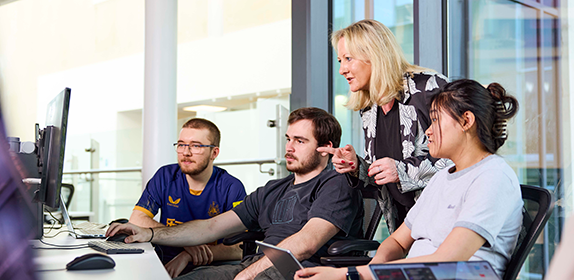
Learning is practice-focused and mirrors real-world challenges, encouraging you to think critically and collaborate effectively. With access to modern facilities and online resources, you'll be prepared with industry-informed skills, to engage with emerging technologies and contribute to the design of inclusive, accessible, and innovative digital experiences.
Applicants should normally have:
A minimum of a 2:2 honours degree in any subject. Other subject qualifications, equivalent professional qualifications and/or relevant work experience will be considered on an individual basis.
International qualifications:
If you have studied a non UK qualification, you can see how your qualifications compare to the standard entry criteria, by selecting the country that you received the qualification in, from our country pages. Visit www.northumbria.ac.uk/yourcountry
English language requirements:
International applicants are required to have a minimum overall IELTS (Academic) score of 6.5 with 5.5 in each component (or approved equivalent*).
*The university accepts a large number of UK and International Qualifications in place of IELTS. You can find details of acceptable tests and the required grades you will need in our English Language section. Visit www.northumbria.ac.uk/englishqualifications
Full UK Fee: £11,250
Tuition fees in the academic year 2027/28* will be £10,050 (subject to Parliamentary approval, along with 2026/27 fees) Fees are set in line with the UK Government's tuition fee cap. The University may increase fees in subsequent years in line with any changes to the tuition fee cap. Increases will be linked to inflation. For example, increases may be linked to RPIX (Retail Price Index excluding mortgage interest payments) Students will be notified of any increase ahead of it taking effect. Student fee loans rise in line with the tuition fees cap.
*if your course is longer than one year
Full International Fee: £21,500
This is the tuition fee for your first year of study. You should expect to pay tuition fees for every year of study. The University may increase fees in the second and subsequent years of your course at our discretion in line with any inflationary or other uplift. Students will be notified of any increase ahead of it taking effect.
Scholarships and Discounts
ADDITIONAL COSTS
There are no Additional Costs
Module information is indicative and is reviewed annually therefore may be subject to change. Applicants will be informed if there are any changes.
KV7008 -
Programming with Python (Core,20 Credits)
In this module you will learn the tools and techniques required to build software systems using a programming language such as Python. You will be introduced to core programming concepts, master their use and get practical experience of how to apply them in appropriate contexts. Specifically, this will comprise developing a working knowledge of variables and types, operators and conditional statements, looping structures and functions, as well as more sophisticated data structures (e.g. lists and classes) and working with files. Using a modern Integrated Development Environment (IDE) you will be exploring fundamental programming principles applicable to modern programming languages including, debugging, testing and error-handling, modularity and code reuse, and discover programming paradigms, for example Object-Oriented Programming (OOP). Overall, you will develop and apply your skills using contemporary development libraries and hone your professional practice through learning industry standard software design principles.
More informationKV7009 -
Ethical and Responsible Computing (Core,20 Credits)
Computing technologies have a range of effects on society, which will be explored in this module. Drawing on relevant theory and research, key issues will be introduced and critically evaluated. Seminars provide the opportunity to critically reflect, and develop skills in verbal communication, around the role of computing professionals in the development and application of technology within society. This module considers topics such as the commercial contexts and drivers which shape computing products, the types of harms and exclusion which arise in an increasingly digital society, the use of technology by governments to provide civic services, and debates around the effects of technology on children and young people. The presentation, potential moral panic and hyperbole around emergent technologies such as AI, and the social media landscape will also be contextualised theoretically. This module presents a holistic view of ethical and responsible computing which not only identifies harms, but also a diverse range of opportunities to create new economic markets, empower individuals, and provide a forum for the sharing of information to challenge existing power structures, e.g. the Panama papers, whistleblowing and ethical hacking. You learn how to identify and use evidence to construct argument, and identify the possible risks, exclusions and harms your work as a computing professional may potentially give rise too, and how to mitigate these.
More informationKV7010 -
Principles of HCI (Core,20 Credits)
You will gain a foundational understanding of Human-Computer Interaction (HCI) as a discipline that bridges psychology, computing, design, and ethics. The module introduces you to key HCI theories (e.g. mental models, embodied interaction, value-sensitive design), methods (e.g. diary studies, cultural probes), and real-world application areas (e.g. workplace, healthcare, finance). You will learn how HCI has evolved across its three historical waves, and how this evolution informs the development of technologies in all aspects of life. Each week we will explore different topics/domains as case studies of contemporary challenges where HCI plays a critical role.
Example of contemporary challenges addressed in the module include (but are not limited to):
• Workplace automation and emerging forms of labour
• Designing for access, equity, and neurodiversity
• Rethinking attention, and overload in digital life
• Navigating health tracking, self-diagnosis, and care through digital tools
By the end of the module, you will be able to interpret human-technology interactions using appropriate theoretical and methodological tools, and to reflect on how different perspectives (including ethical, social, and cultural) shape the design of user experiences. You will also learn to express HCI insights through creative and research-informed visual formats.
KV7011 -
Multimodal Interfaces (Core,20 Credits)
In this module you will learn how to evaluate and select appropriate interaction modalities based on their affordances and be able to justify and articulate how they support different forms of interaction. You will demonstrate how you can configure multiple interaction modalities to meet a specific scenario and apply relevant theories and concerns to critically engage with your design.
Indicative topics include:
• Direct Interaction (e.g. touch, multi-touch, pens, direct interaction, AR manipulation)
• In-direct Interaction (e.g. mouse, game controllers, VR pointing)
• Embodied Interaction (e.g. wearables, body tracking, performative interaction, exercise interaction)
• Tangible Interaction (e.g. embedded computing, RFID, buttons, knobs)
• Output Modalities (e.g. screens, paper, light indicators, dials, sound, haptics)
Cross-cutting themes:
• Sustainability (of the required hardware, and of the interaction techniques) e.g. Energy-conscious design, designing for longevity and reuse.
• Interaction Patterns (e.g. IoT wifi connections, touch-screen design, one-button interfaces)
• Theories of interaction (Kinesthetics, Proxemics, FITTS law)
• Accessibility
• Degrees of Freedom
• XR Interaction (tracking, pointing etc)
KV7012 -
AI as a Design Material (Core,20 Credits)
The core of this module is learning about different approaches to dialogues with materials drawing on different disciplines and contexts. First you will be introduced to the main theories and ideas behind that modality (e.g. text, language and natural language processing) and then you will engage in a practical workshop where, through practical engagement, we will consider how practitioners engage with that modality. If using non-digital methods, we will critically consider how these principles apply to HCI and AI design practices, collectively addressing the question of what does AI materiality look like, and how can we use it as a design material? This module is at the cutting edge of contemporary thinking around artificial intelligence, and the module content will draw heavily on cutting edge language (and multi-modal) models, so it is expected to change in light of contemporary thinking around the topic.
The different material practices we will consider include (but are not limited to):
• Language, text and natural language processing
• Computer vision, perception, photography, film & graphic design
• Audio and sound design, text-to-speech synthesis, music generation and ambient sound processing as design materials
• Gesture and movement - investigating motion capture, gesture recognition, kinaesthetic interfaces, and embodied interaction as modalities for human-AI dialogue
• Spatial and 3D modelling - considering volumetric capture, spatial computing, AR/VR environments, and 3D modelling (physical and digital) as design materials
• Data visualization and information design - considering how data becomes material through visualization, dashboard design, and information architecture in AI systems
• Collaborative and social interfaces - exploring conversational AI, chatbots, social robotics, and collective intelligence systems as material practices
By the end of the module, you will be able to apply a diverse range of material design practices to AI design, demonstrating knowledge around different modalities and their critical application. You will have critically analysed theories and frameworks in different disciplines in how they apply to AI as a design material.
KV7013 -
User Interaction and Usability Testing (Core,20 Credits)
On this module, you will gain an understanding of how to evaluate interactive technologies through the lens of User Experience (UX) Design. You will study a range of established and emerging UX evaluation methods, developing the ability to critically assess how technologies align with user needs, behaviours, and contextual factors in real-world environments.
Key areas of study include:
• UX evaluation frameworks and methodologies, including both formative and summative approaches.
• Heuristic evaluation, cognitive walkthroughs, and task-based usability testing.
• Quantitative and qualitative data collection techniques, such as performance metrics, satisfaction surveys, and think-aloud protocols.
• Advanced UX evaluation tools, with a particular focus on eye-tracking to explore visual attention and cognitive load.
• The challenges of evaluating ubiquitous, wearable, and mobile technologies, including spatial, temporal, and environmental considerations.
• The role of user-centred design principles in shaping evaluation strategies.
• Data analysis and interpretation, enabling you to derive actionable insights and make evidence-based design recommendations.
You will apply these methods in hands-on, practical investigations, assessing real-world systems through iterative evaluations. By the end of the module, you will be equipped to conduct robust UX research, critically reflect on the evaluation process, and communicate findings effectively key competencies for professional roles in HCI, UX research, and digital product design.
KV7014 -
MSc Capstone Project (Core,60 Credits)
This module will involve conducting a substantial individual research project relevant to your programme of study, based within the broader sphere of computer science and related disciplines. Over the course of completing this module, you will employ skills developed throughout your programme and will augment these with a variety of new skills and abilities which will allow you to complete an original research project and present the outputs of this process in both written and oral forms. This will include not only the specialist technical knowledge required to undertake innovative and rigorous research, but also a range of transferrable professional skills including communication (written and oral), literature searching and reviewing, research methods and design, project management, and personal time management. You will have guest input from external speakers from industry, to highlight and underscore how employers value these core skills as professionally valuable. During the creation of a project approval document, you will be required to engage with the University’s research ethics process and to consider any legal, societal and professional issues raised by your research project.
More informationThis course aims to equip you with the necessary skills to pursue career paths such as user experience (UX), user interface (UI) design, user research, human factor engineering or service design. You'll attain a range of industry standard skills, along with ability to communicate with technical and non-technical audiences, apply computational thinking, work independently as a reflective practitioner, and collaborate effectively. These skills are in demand both nationally and internationally, and will allow you to work for diverse employer types.
You'll develop specialised and transferable skills that can be applied to employability or further study through experiential learning, drawing on laboratory work, simulations and problem-based learning to provide an authentic learning experience.
Through your capstone project and other course content, there are opportunities to practice and develop independent project management skills, respond dynamically to challenges, and work sensitively in complex contexts and scenarios to become a skilled computer science professional.
Our staff are experts in HCI, with a strong teaching focus and experience. Teaching focuses on introducing real-world scenarios and problems to illustrate the link between theory and practical application of skillsets in real-world contexts.
Staff have worked on projects such as precarity in working in the gig economy, representation in Instagram imagery, the availability of charging infrastructure for electric wheelchairs, and worked with national and international partner organisations such as the Red Cross.
You'll learn from experts in accessibility and inclusion in technology design, working with communities and participatory methods, developing bespoke interactive interfaces, and working in cutting-edge contexts such as social media analysis and human-centred AI.
This is a research-rich course that incorporates research into the teaching in multiple ways.
You'll be introduced to contemporary HCI research across health and wellbeing, the world of work, and social media, and given the opportunity to critically interrogate its implications and weaknesses.
You'll also be introduced to academic skills and practices in conducting your own research for the final capstone project and applying industry skills, such as eye tracking, as methods. Your knowledge base will be underpinned by faculty introducing core research which has produced models, frameworks and toolkits commonly used in HCI.
As a School of Computer Science student, you’ll benefit from modern facilities that support flexible, collaborative, and hands-on learning.
You’ll study in the purpose-built, £7m Computer and Information Sciences building—designed as a sustainable Smart Building and home to dedicated computing spaces, teaching labs, and collaboration zones.
Technology Enhanced Learning (TEL) is embedded throughout the course, with digital tools such as Claude for Education and Blackboard eLearning Portal. Blackboard serves as a virtual learning environment, offering access to reading lists, digital learning materials, and announcements and messages from tutors.
Outside of the classroom, you'll have access to quiet study spaces and areas for social and collaborative working at our City Campus Library and University Library Digital Commons. These spaces are open 24/7 during term-time.
All information is accurate at the time of sharing.
Full time Courses are primarily delivered via on-campus face to face learning but could include elements of online learning. Most courses run as planned and as promoted on our website and via our marketing materials, but if there are any substantial changes (as determined by the Competition and Markets Authority) to a course or there is the potential that course may be withdrawn, we will notify all affected applicants as soon as possible with advice and guidance regarding their options. It is also important to be aware that optional modules listed on course pages may be subject to change depending on uptake numbers each year.
Contact time is subject to increase or decrease in line with possible restrictions imposed by the government or the University in the interest of maintaining the health and safety and wellbeing of students, staff, and visitors if this is deemed necessary in future.
Useful Links
Find out about our distinctive approach at
www.northumbria.ac.uk/exp
Admissions Terms and Conditions
northumbria.ac.uk/terms
Fees and Funding
northumbria.ac.uk/fees
Admissions Policy
northumbria.ac.uk/adpolicy
Admissions Complaints Policy
northumbria.ac.uk/complaints