Computer Science MSc
16 Months Full-Time | September or January Start
Option for Placement Year
Option for Study Abroad

International
View our Global FootprintBusiness
Northumbria University is proud to offer a range of Professional, Statutory and Regulatory Body (PSRB) approved & accredited courses and programmes. Explore our list of courses and programmes under our Education and Training page.
More on our Business ServicesResearch
Northumbria is a research-rich, business-focused, professional university with a global reputation for academic quality. We conduct ground-breaking research that is responsive to the science & technology, health & well being, economic and social and arts & cultural needs for the communities
Discover more about our ResearchAlumni
Northumbria University is renowned for the calibre of its business-ready graduates. Our alumni network has over 253,000 graduates based in 178 countries worldwide in a range of sectors, our alumni are making a real impact on the world.
Our AlumniIf you’d like to receive the latest updates from Northumbria about our courses, events, finance & funding then enter your details below.
* At Northumbria we are strongly committed to protecting the privacy of personal data. To view the University’s Privacy Notice please click here
Option for Placement Year
Option for Study Abroad

Whilst studying Computer Science MSc, you will develop broad knowledge and skills in areas such as web development, computer networks and database modelling.
Whether you are looking for a brand new challenge or to refine your existing knowledge and expertise, this degree will help you on your way to a high earning career in computer science, and we welcome students without a background in Computing.
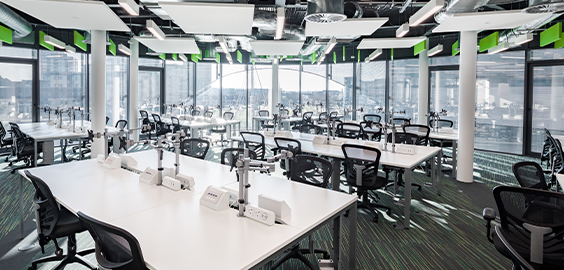
Designed in consultation with partners from industry, you'll develop the most up-to-date computing knowledge, tailor-made to fulfil employment demand. Throughout the duration of the course, you'll have access to our state-of-the-art facilities. This includes our new Computer and Information Sciences building, where you will have access to dedicated IT systems evenings and weekends. Our equipment is industry leading and absolutely state of the art, meaning that you will graduate familiar with industry standard equipment.
Graduates are expected to work in a number of career opportunities across a wide range of specialist computing areas. This will include software engineering, systems analysis and design, computer networks, database development and management, software testing and project management. Graduates have also set themselves up as IT consultants, or joined existing consultancy firms.
Already have an undergraduate degree in a computing-related subject? Advanced Computer Science MSc or our Advanced Computer Science with Advanced Practice MSc is the course you'll need to take your knowledge to the next level.
Accreditation: Accredited by BCS (The Chartered Institute for IT) for the purposes of partially meeting the academic requirement for registration as a Chartered IT Professional.
See other similar courses you may be interested in: Human-Computer Interaction MSc
Whilst studying Computer Science MSc, you will develop broad knowledge and skills in areas such as web development, computer networks and database modelling.

Whether you are looking for a brand new challenge or to refine your existing knowledge and expertise, this degree will help you on your way to a high earning career in computer science, and we welcome students without a background in Computing.
Designed in consultation with partners from industry, you'll develop the most up-to-date computing knowledge, tailor-made to fulfil employment demand. Throughout the duration of the course, you'll have access to our state-of-the-art facilities. This includes our new Computer and Information Sciences building, where you will have access to dedicated IT systems evenings and weekends. Our equipment is industry leading and absolutely state of the art, meaning that you will graduate familiar with industry standard equipment.
Graduates are expected to work in a number of career opportunities across a wide range of specialist computing areas. This will include software engineering, systems analysis and design, computer networks, database development and management, software testing and project management. Graduates have also set themselves up as IT consultants, or joined existing consultancy firms.
Already have an undergraduate degree in a computing-related subject? Advanced Computer Science MSc or our Advanced Computer Science with Advanced Practice MSc is the course you'll need to take your knowledge to the next level.
Accreditation: Accredited by BCS (The Chartered Institute for IT) for the purposes of partially meeting the academic requirement for registration as a Chartered IT Professional.
See other similar courses you may be interested in: Human-Computer Interaction MSc
Level of Study
Postgraduate
Mode of Study
16 months Full Time
2 other options available
School
Computer Science
Location
City Campus, Northumbria University
City
Newcastle
Start
September or January
Fees
Fee Information
Modules
Module Information
On this course, you will have the opportunity to independently research topics to deepen your learning and understanding, while learning the skills to communicate your research and investigations.
Assessment methods will include reports, presentations, individual, group and project work, alongside regular feedback on your summative assessment.
Our experienced staff will be assigned to you on an 1-1 basis to support your chosen research topic towards the end of the programme. You will be taught through a range of lectures, seminars, tutorials and workshops. Throughout the programme, there is an emphasis upon self-directed learning, critical thinking, and independent research to support your academic and personal development.
You will be taught by a range of academic staff who bring a wealth of professional experience. They are experts in specialist areas such as strategic management, programming, web based information retrieval, research methods and project management.
In a dynamic learning environment with an expert team of staff, you will be taught theoretical and practical research skills such as information literacy, as well as problem solving skills, self-directed learning and communication skills.
For this full time Master's programme you will have approximately 13 hours of teaching time per week. Class time can occur anytime between 9am-6pm, Monday to Friday (exact timetables will be finalised in early September).
Throughout the duration of your course you will have access to our state-of-the-art facilities including our new Computer and Information Sciences building, this gives you access to dedicated IT systems and is available evenings and weekends.
You will also have access to the University’s award winning library (online and on campus). The library achieved the second highest score in the UK in the Times Higher Student Satisfaction Survey 2015.
In addition to direct academic assistance, you will have access to a variety of learning support options. Workshops led by library experts will teach you how to correctly reference sources and enhance your academic writing skills. The electronic learning portal will also provide you with access to a selection of online support materials, including Blackboard Ultra.
Explore our Computer and Information Sciences building.
You will be immersed in a research-rich environment supported by our rapidly expanding Computer Science and Information Science Research Groups.
Northumbria's MSc has been designed to ensure you learn the most up-to-date computing knowledge required by employers across the industry. We offer research-informed teaching, industry-standard software and a strong community of like-minded students.
You will develop an understanding of important research methods, techniques and approaches which could be directly applicable to the demands of your future career.
Click through to discover our current research areas
Upon graduating from this course, MSc Computer Science, you will have an in-depth knowledge and critical understanding of the subjects main areas, including the key areas of systems analysis, systems development, operating systems, networking, databases and the internet.
We place a real emphasis on developing the transferable skills that will open doors to a range of careers. These include communication, analytical and problem solving skills, technical skills and the ability to work independently and as part of a team.
Graduates are expected to work in a number of career opportunities across a wide range of computer areas including software engineering, systems analysis and design, computer networks, database development and management, software testing and project management. Graduates have also set themselves up as IT consultants, or joined existing consultancy firms.
Meet our current and former Computing students
Take a look at what Northumbria has to offer and discover what studying with us can do for you.
Applicants should normally have:
A minimum of a 2:2 honours degree in any subject. Other subject qualifications, equivalent professional qualifications and/or relevant work experience will be considered on an individual basis.
International qualifications:
If you have studied a non UK qualification, you can see how your qualifications compare to the standard entry criteria, by selecting the country that you received the qualification in, from our country pages. Visit www.northumbria.ac.uk/yourcountry
English language requirements:
International applicants are required to have a minimum overall IELTS (Academic) score of 6.5 with 5.5 in each component (or approved equivalent*).
*The university accepts a large number of UK and International Qualifications in place of IELTS. You can find details of acceptable tests and the required grades you will need in our English Language section. Visit www.northumbria.ac.uk/englishqualifications
Full UK Fee: £11,250
Tuition fees in the academic year 2027/28* will be £10,050. Fees are set in line with the UK Government's tuition fee cap. The University may increase fees in subsequent years in line with any changes to the tuition fee cap. Increases will be linked to inflation. For example, increases may be linked to RPIX (Retail Price Index excluding mortgage interest payments) Students will be notified of any increase ahead of it taking effect. Student fee loans rise in line with the tuition fees cap.
*if your course is longer than one year
Full International Fee: £21,500
This is the tuition fee for your first year of study. You should expect to pay tuition fees for every year of study. The University may increase fees in the second and subsequent years of your course at our discretion in line with any inflationary or other uplift. Students will be notified of any increase ahead of it taking effect.
Scholarships and Discounts
ADDITIONAL COSTS
TBC
* At Northumbria we are strongly committed to protecting the privacy of personal data. To view the University’s Privacy Notice please click here
Module information is indicative and is reviewed annually therefore may be subject to change. Applicants will be informed if there are any changes.
KF7011 -
Systems Analysis & Design with UML (Core,20 Credits)
In this module you will learn about methods of analysing and designing information systems using object-oriented methods. You will gain an understanding of the general IT system development lifecycle and the activities and personnel roles applicable at each lifecycle stage, and of the concepts of professional standards and codes for systems analysis and design projects. This will include learning how to specify system requirements and use systems analysis and design techniques to develop workable solutions to business information system problems. You will be learn and apply an object-oriented approach to develop information systems projects using the techniques of the Unified Modelling Language (UML) - the leading notation used for specifying systems. This will include advanced modelling concepts and techniques that are used to build complex object models. In particular, the syllabus of the module will cover topics such as:
• Information systems: information systems to support organisational types and objectives; strategic, tactical, operational and control systems
• Systems development activities and lifecycles: the systems development lifecycle, rationale for 'staged' system development and the key stages, roles and deliverables; the role of prototyping and iterative development; Unified System Development Process (USDP) or another lifecycle for object-oriented development
• Systems investigation techniques: the key areas of system investigation and applicable fact-finding techniques - interviewing, document examination, observation etc.
• Systems specification techniques using an object-oriented approach: defining the problem statement and structuring it through Use Case Modelling; going from Use Cases to a first-cut behavioural model (communication diagrams) with associated class diagrams; basic modelling syntax.
• Object oriented design: object model-objects, classes, inheritance, generalisation, links and associations; purpose of design; interaction modelling (sequence diagrams) and state machines in design; specifying operations with activity diagrams; design patterns.
• Class and method design: classes, objects, and messages
• Data Management Layer Design: relationship database, object-oriented database design, data access design and manipulation classes
• Human-Computer Interaction Layer Design: including principles for user interface design, content awareness, user experience, etc
• Physical layer design: including elements of the physical architecture layer, architectural components, infrastructure design, etc
• Construction: including programming management, documentation, and testing
• Professional codes of practice: the need for professional standards within analysis and design; British Computer Society, the Chartered Institute for IT codes.
KF7013 -
Website Development and Deployment (Core,20 Credits)
On this module you will learn the requirements for developing secure web applications to industry standards, including the technical and architectural components of the web, considering accessibility issues. You will learn how to apply the tools and techniques required for secure web development and develop practical skills to build a web application that interacts with a database. Issues associated with the deployment of a web application will be discussed, including how to audit and correct security deficiencies by following leading industrial practice.
The syllabus of the module will include:
• The technical and architectural components of the web
• HTML and CSS and their application to building a web site
• Client and Server programming to deploy a secure web application that interacts with a database
• Security issues in the deployment of a web application that is both usable and accessible
KF7023 -
Computer Networks & Operating Systems (Core,20 Credits)
This module provides you with a critical appreciation of networks and operating systems. You will learn about the organisation and operation of computing systems, relevant concepts and technologies at a technical level, and the demands placed upon computer systems and the computer networks and operating systems technologies required for them to successfully support current and emerging applications. In particular, the syllabus of the module will cover topics such as:
• Systems Software Hierarch
• Operating Systems Architecture
• Operating System Issues, e.g., scheduling
• Data Communications and Networking
• Network Architectures, e.g., OSI model
• Major Internet Protocols and Technologies, e.g., TCP Internet Protocol
• System Security and Protection, e.g., Encryption
• Professional Practice and Related Legal, Ethical and Social issues.
KF7028 -
Research Methods and Project Management (Core,20 Credits)
In this module you will learn about research and the processes involved in carrying out research in the area of computer and information sciences. The module will encompass the full research cycle from development of the initial concept through to final evaluation and reflection on your research. You will learn how to search, find and evaluate the literature and how to use this to construct a critical literature review. You will also be able to gain an understanding of different research methods and techniques and how to apply them in practice. You will be given the opportunity to gain expertise in data and information analysis, from data collection through to the analysis, presentation and interpretation of results. You will be able to critically evaluate and reflect on the research process. You will also learn about ethics and professional conduct whilst undertaking research and consider and manage risk (including health and safety) and legal, societal and sustainability issues with respect to a research project.
Alongside this you will be provided with the skills and techniques to effectively manage a project from start to finish, including the planning and monitoring aspects.
KV7008 -
Programming with Python (Core,20 Credits)
In this module you will learn the tools and techniques required to build software systems using a programming language such as Python. You will be introduced to core programming concepts, master their use and get practical experience of how to apply them in appropriate contexts. Specifically, this will comprise developing a working knowledge of variables and types, operators and conditional statements, looping structures and functions, as well as more sophisticated data structures (e.g. lists and classes) and working with files. Using a modern Integrated Development Environment (IDE) you will be exploring fundamental programming principles applicable to modern programming languages including, debugging, testing and error-handling, modularity and code reuse, and discover programming paradigms, for example Object-Oriented Programming (OOP). Overall, you will develop and apply your skills using contemporary development libraries and hone your professional practice through learning industry standard software design principles.
More informationKV7009 -
Ethical and Responsible Computing (Core,20 Credits)
Computing technologies have a range of effects on society, which will be explored in this module. Drawing on relevant theory and research, key issues will be introduced and critically evaluated. Seminars provide the opportunity to critically reflect, and develop skills in verbal communication, around the role of computing professionals in the development and application of technology within society. This module considers topics such as the commercial contexts and drivers which shape computing products, the types of harms and exclusion which arise in an increasingly digital society, the use of technology by governments to provide civic services, and debates around the effects of technology on children and young people. The presentation, potential moral panic and hyperbole around emergent technologies such as AI, and the social media landscape will also be contextualised theoretically. This module presents a holistic view of ethical and responsible computing which not only identifies harms, but also a diverse range of opportunities to create new economic markets, empower individuals, and provide a forum for the sharing of information to challenge existing power structures, e.g. the Panama papers, whistleblowing and ethical hacking. You learn how to identify and use evidence to construct argument, and identify the possible risks, exclusions and harms your work as a computing professional may potentially give rise too, and how to mitigate these.
More informationSE7000 -
Skills for Academic Success in a UK University (Core – for International and EU students only,0 Credits)
You will develop your understanding of academic conventions in UK higher education aligned to your level of study, including expectations around critical analysis, structure, argumentation, evidencing, and referencing. The module focuses on developing communication strategies that will help you express your ideas clearly and coherently in written assignments and spoken activities. You will also reflect on your current academic and language skills and develop strategies for development ahead of your assessments.
More informationKF7029 -
MSc Computer Science & Digital Technologies Project (Core,60 Credits)
The aim of this module is to enable you to undertake a substantial academic research project at Masters level, record your progress though this, and present the results from your research in both written and oral forms. Your research project will be a major piece of independent and original research centred at the forefront of your programme discipline within the wider sphere of computer and information sciences.
You will experience the full life cycle of a research project from initial conception and development of a research proposal, through a critical review of the literature, planning, design, implementation and analysis of your main research project, to final evaluation, reflection and dissemination. You will be expected to conduct your research in an ethical and professional manner, and manage risk and consideration of the legal, societal and sustainability issues applicable, to this academic research project. You will also be expected to apply your expertise, project management and practical skills within your particular domain of computer and information sciences and demonstrate critical and innovative thinking and problem solving within a research environment.
The following alternative study options are available for this course:
Sep start
Sep, Jan start
To start your application, simply select the month you would like to start your course.
Our Applicant Services team will be happy to help. They can be contacted on 0191 406 0901 or by using our Contact Form.
Full time Courses are primarily delivered via on-campus face to face learning but could include elements of online learning. Most courses run as planned and as promoted on our website and via our marketing materials, but if there are any substantial changes (as determined by the Competition and Markets Authority) to a course or there is the potential that course may be withdrawn, we will notify all affected applicants as soon as possible with advice and guidance regarding their options. It is also important to be aware that optional modules listed on course pages may be subject to change depending on uptake numbers each year.
Contact time is subject to increase or decrease in line with possible restrictions imposed by the government or the University in the interest of maintaining the health and safety and wellbeing of students, staff, and visitors if this is deemed necessary in future.
Northumbria University is committed to developing an inclusive, diverse and accessible campus and wider University community and are determined to ensure that opportunities we provide are open to all.
We are proud to work in partnership with AccessAble to provide Detailed Access Guides to our buildings and facilities across our City, Coach Lane and London Campuses. A Detailed Access Guide lets you know what access will be like when you visit somewhere. It looks at the route you will use getting in and what is available inside. All guides have Accessibility Symbols that give you a quick overview of what is available, and photographs to show you what to expect. The guides are produced by trained surveyors who visit our campuses annually to ensure you have trusted and accurate information.
You can use Northumbria’s AccessAble Guides anytime to check the accessibility of a building or facility and to plan your routes and journeys. Search by location, building or accessibility feature to find the information you need.
We are dedicated to helping students who may require additional support during their student journey and offer 1-1 advice and guidance appropriate to individual requirements. If you feel you may need additional support you can find out more about what we offer here where you can also contact us with any questions you may have:
Page last updated 06/08/26
If you’d like to receive the latest updates from Northumbria about our courses, events, finance & funding then enter your details below.
* At Northumbria we are strongly committed to protecting the privacy of personal data. To view the University’s Privacy Notice please click here