New platform maps charity support for the Armed Forces community
Pioneering data platform maps where the Armed Forces community receive support from charities

We have a strong working relationship with Newcastle United Football Club. In addition to many placements for undergraduate and postgraduate students, we have some specific ongoing doctoral research projects. Previous and current research with the club focus on numerous areas of human performance that affect the academy and senior club players.
A good deal of this work conducted with Richard Akenhaed and John Fitzpatrick has been to understand the physiological stress imposed by elite football and how this can be quantified. Other areas of football related research have focussed on understanding recovery with Callum Brownstein and most recently, Ruth Boldon is investigating nutritional interventions for metabolic health in academy players. The most recent additions to this suite of applied research is with Kieran Taylor who started his doctoral work the 1st team in the area of performance analysis and Michael Harding examining injury recovery as part of the medical supporting the 1st team squad.

In recent years we have received funding from the UEFA Research Grant programme. Specifically in 2015, from the 52 applications received amongst 25 different UEFA member associations, Dr Kevin Thomas’ application titled ‘Optimising player performance and readiness to train: Fatigue and recovery of neuromuscular function following football match-play’ was one of six projects chosen. Briefly, the investigation studied the fatigue that manifests during a simulated soccer match play and reported how long players take to recover.
A full
report of this investigation can be found on page 8 of the October 2016
publication UEFA Direct. By encouraging
cooperation between the national associations and the academic community, UEFA
hopes to help get research projects off the ground that the associations can
then use in order to further develop their own activities and projects. In
addition to this work there are a number of works that have examined numerous
aspects of football performance - a sample of which are presented below:
Brownstein, C. G., Dent, J. P., Parker, P., Hicks, K. M., Howatson, G., Goodall, S., & Thomas, K. (2017). Etiology and recovery of neuromuscular fatigue following competitive soccer match-play. Frontiers in Physiology, 8, 831. http://nrl.northumbria.ac.uk/32519/
Goodall, S., Thomas, K., Harper, L. D., Hunter, R., Parker, P., Stevenson, E., ... & Howatson, G. (2017). The assessment of neuromuscular fatigue during 120 min of simulated soccer exercise. European Journal of Applied Physiology, 117(4), 687-697. http://nrl.northumbria.ac.uk/29844/
Thomas, K., Dent, J., Howatson, G., & Goodall, S. (2017). Etiology and recovery of neuromuscular fatigue following simulated soccer match-play. Medicine & Science in Sports & Exercise, 49(5), 955-964. http://nrl.northumbria.ac.uk/29020/
Hodgson, C., Akenhead, R., & Thomas, K. (2014). Time-motion analysis of acceleration demands of 4v4 small-sided soccer games played on different pitch sizes. Human Movement Science, 33, 25-32. http://nrl.northumbria.ac.uk/15626/
Fitzpatrick, J. F., Hicks, K. M., & Hayes, P. R. (2018). Dose-Response Relationship between Training Load and Changes in Aerobic Fitness in Professional Youth Soccer Players. International Journal of Sports Physiology & Performance, 1-22. http://nrl.northumbria.ac.uk/34469/
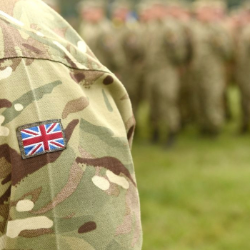
Pioneering data platform maps where the Armed Forces community receive support from charities

A major study co-led by Northumbria University will test whether attachment assessments lead…

New research published today by the AHRC Creative Communities programme provides fresh evidence…

Northumbria University's award-winning Student Law Office is launching SEND Decoded, a series…

The Net Zero Polar Science (NZPS) Doctoral Training Programme (DTP) has welcomed its first…

A new drop-in service is bringing health and wellbeing support for students at both Newcastle…

A new project led by Northumbria University aims to grow optical fibres using proteins, mimicking…

Northumbria University has hosted a major international workshop, bringing together leading…
The Great Hall, Sutherland Building
-

Manchester Marriott Hotel Piccadilly
-

Sutherland Building
Page last reviewed: 25 January 2024
