


New platform maps charity support for the Armed Forces community
Pioneering data platform maps where the Armed Forces community receive support from charities

Simulating partial gravity on Earth is harder than it sounds. The body weighs the same regardless of where you are; the question is how to offload it convincingly. Most existing approaches – harnesses pulling the subject vertically, lower-body positive pressure chambers, neutral buoyancy – produce artefacts that compromise movement fidelity. They distort how limbs move relative to each other, restrict natural trunk dynamics, or simply cannot replicate the directional component of gravity that determines ground reaction force.
VGSS was designed from first principles to solve these problems.
The core insight of VGSS is that if a participant is oriented perpendicular to an inclined treadmill, the component of Earth's gravity acting along their body axis – and therefore the force driving them onto the treadmill surface – is determined by the angle of inclination. At 9.5° of inclination, that axial component is 0.16g: the gravitational acceleration on the Moon. No harness loading is required. The participant's own weight, resolved along their body axis, provides the correct gravitational force.
This produces ground reaction forces that are authentic in both magnitude and direction – something no harness-pull system achieves.
To hold the participant in this orientation without Earth's full 1g acting through their body, each body segment is individually supported:
The universal joint is critical. It allows the thorax to rotate relative to the pelvis – as it does during normal walking and running – preserving the natural counter-rotation of the upper and lower body. Systems that place participants on a rigid board eliminate this motion entirely.
The constant-tension cable design ensures that as a limb moves, the cable does not load or unload the segment. This is in contrast to elastic cord systems, where the effective load on a limb changes through the movement cycle.
Five pairs of linear actuators adjust the position of gantry-mounted pulleys above the participant. This allows cable angles to be set specifically for each participant's anthropometry, ensuring cables run at the correct angles for the target gravity level and the participant's body proportions. Setup positions are recorded and can be reproduced precisely across sessions.
The treadmill is mounted on two AMTI OR6-7 six-degree-of-freedom force platforms, providing continuous ground reaction force measurement across the full treadmill surface. A draw-wire sensor can measure centre-of-mass displacement or jump height. Motion-capture systems (2D or 3D) can track whole body kinematics.
A real-time biofeedback display – unique to VGSS – shows participants their jump height, allowing protocol-consistent ballistic tasks.
| Parameter | Current specification | From 2027 (NESST) |
| Gravity range | 0g – 0.16g (lunar) |
0g – 0.38g (Martian) |
| Safe working load | 125 kg |
TBC (increased) |
| Suspension rope length | ~2 m |
~8 m |
| Headroom above participant | ~1 m |
~5 m |
| Treadmill activity modes | Walking, running, jumping |
Walking, running, jumping |
| Force measurement | 2× AMTI OR6-7 6-DoF force platforms |
As current |
| Motion capture | 6-camera Vicon Vero, Xsens, 2D video | As current |
| Physiological measurement | VO₂, ECG, BP, wireless EMG, NIRS, blood sampling | As current |
| Data acquisition | Bespoke LabVIEW-based integrated software | As current |
| Gravity level setting | Fixed per session (treadmill inclination) | As current |
| Operational status | TRL 9, fully operational | As current |
| Feature | VGSS | NASA ZLS | ESA VTF |
| True axial hypogravity (no harness loading) | ✓ | ✗ |
✗ |
| Independent limb suspension | ✓ | Partial (elastic, not constant-tension | ✗ (limbs coupled) |
| Three-dimensional trunk articulation | ✓ | ✗ (rigid board) |
✗ (rigid board) |
| Lunar gravity simulation (0.17g) | ✓ | ✗ |
✗ |
| Martian gravity simulation (0.38g) | ✓ (from 2027) | ✗ |
✗ |
| Integrated force platform | ✓ | ✓ | ✓ |
| Real-time biofeedback | ✓ | ✗ |
✗ |
| Integrated physiological monitoring | ✓ | ✓ |
✓ |
In 2027, VGSS will relocate to a dedicated two-floor laboratory in the North East Space Skills and Technology Centre (NESST) at Northumbria University. The new laboratory has been designed specifically around VGSS, with suspension ropes passing through a 1-metre cutout between floors to achieve an 8-metre rope length.
This will extend the achievable gravity range to 0.38g (Martian), increase jump headroom to approximately 5 metres, and allow a broader range of locomotor and ballistic tasks. The increased suspension rope length will also increase the system’s fidelity in simulating individual g-levels.
The NESST facility will position VGSS as one of the most capable partial-gravity simulation platforms in the world.
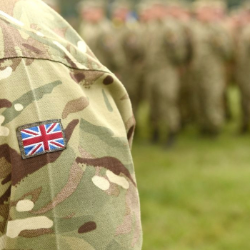
Pioneering data platform maps where the Armed Forces community receive support from charities

A major study co-led by Northumbria University will test whether attachment assessments lead…

New research published today by the AHRC Creative Communities programme provides fresh evidence…

Northumbria University's award-winning Student Law Office is launching SEND Decoded, a series…

The Net Zero Polar Science (NZPS) Doctoral Training Programme (DTP) has welcomed its first…

A new drop-in service is bringing health and wellbeing support for students at both Newcastle…

A new project led by Northumbria University aims to grow optical fibres using proteins, mimicking…

Northumbria University has hosted a major international workshop, bringing together leading…

Europa Hotel
-
The Great Hall, Sutherland Building
-
Manchester Marriott Hotel Piccadilly
-
Page last reviewed: 14 May 2026
