
A new analysis of decades of research on the Antarctic Peninsula, involving experts from Northumbria University, concludes that the next ten years of climate action will decide Antarctica’s future for centuries to come.
Pale expanses of ice keep water locked up and reflect heat from the planet in Antarctica — but the climate crisis is putting these safeguards under increasing pressure. Rising temperatures could destroy its ecosystems and put other parts of the planet at risk by driving sea level rise and damaging food chains.
An international group of scientists modelling possible outcomes for the Antarctic Peninsula have outlined the best and worst-case scenarios for climate change in a new paper published in the scientific journal Frontiers in Environmental Science. The results demonstrate just how high the stakes are — but also how much harm can still be prevented.
“The Antarctic Peninsula is a special place,” said Professor Bethan Davies of Newcastle University, lead author on the paper published today. “Its future depends on the choices that we make today. Under a low emissions future, we can avoid the most important and detrimental impacts. However, under a higher emissions scenario, we risk the loss of sea ice, ice shelves, glaciers, and iconic species such as penguins.
“Though Antarctica is far away, changes here will impact the rest of the world through changes in sea level, oceanic and atmospheric connections and circulation changes. Changes in the Antarctic do not stay in the Antarctic.”
The scientists focused on the Antarctic Peninsula as a centre for research, tourism, and fishing which is very well-studied and vulnerable to anthropogenic changes, allowing them to track the effects of global warming on its ecosystem.
Using scenarios which estimate future emissions to model outcomes for the Antarctic Peninsula: low emissions (1.8°C temperature rise compared to preindustrial levels by 2100), medium-high emissions (3.6°C), and very high emissions (4.4°C), they looked at eight different aspects of the Peninsula’s environment affected by climate change. This included marine and terrestrial ecosystems, land and sea ice, ice shelves, the Southern Ocean, the atmosphere, and extreme events like heatwaves.
In higher emissions scenarios, the Southern Ocean will get warmer faster and accelerate the erosion of ice on land and at sea. The higher temperatures get, the more likely ice shelves are to collapse, driving sea level rise.
Professor Alison Banwell, a co-author on the paper from the Centre for Polar Observation and Modelling (CPOM) based at Northumbria University, carried out analysis of the impact on the Peninsula’s ice shelves.
She explained: “Ice shelves act as critical buffers against sea-level rise, holding back Antarctica’s land ice, yet their future remains highly uncertain. They can appear stable for decades before collapsing rapidly once key structural or climatic thresholds are crossed, making these events difficult to capture in models.
“What this study shows is that the future of the Antarctic Peninsula — including its ice shelves — depends strongly on the emissions pathway we follow. Under lower emissions, many of these systems remain stressed but largely intact; under higher emissions, we cross thresholds that lead to irreversible change.
 “The Antarctic
Peninsula is already responding to climate change, but our study shows that
decisions made in the coming decades will be crucial in terms of shaping its
ice, ecosystems, and contribution to sea-level rise for centuries to come.”
“The Antarctic
Peninsula is already responding to climate change, but our study shows that
decisions made in the coming decades will be crucial in terms of shaping its
ice, ecosystems, and contribution to sea-level rise for centuries to come.”
Under the highest emissions scenario, sea ice coverage could fall by 20 per cent, devastating species that rely on it — such as krill, an important prey for whales and penguins — and amplifying ocean warming worldwide. Higher ocean warming would also stress ecosystems and contribute to extreme weather.
Although it’s difficult to predict how these environmental changes would combine to affect animals, the scientists expect that under very high emissions scenarios, many species will move south to escape higher temperatures. Warm-blooded predators may cope with temperature changes, but if their prey can’t, they will starve.
Dr Jan De Rydt, a co-author and researcher in polar glaciology and oceanography from Northumbria University’s School of Geography and Natural Sciences, worked on modelling the impacts on land ice. He added: “It is clear that glaciers along the Antarctic Peninsula will continue to change rapidly in a warming world.
“Exactly how much ice will be lost, and the consequences for oceans and ecosystems, remains an active area of research, requiring integrated oceanographic, atmospheric and glaciological observations and modelling. The UK plays a leading role in this effort, with Northumbria University researchers at the forefront of developing numerical models that advance our understanding of Antarctica’s future."
Researchers aren’t safe from the consequences of climate change either: damage to infrastructure is making it more dangerous to carry out research, so it’s harder to collect the data needed to forecast the future effects of climate change. Although numerical models simplify reality, more data makes them more accurate. However, the scientists emphasise that we must act now to avoid the worst-case scenarios.
“At the moment, we’re on track for a medium to medium-high emissions future,” added Professor Davies. “A lower emissions scenario would mean that although the current trends of ice loss and extreme events would continue, they would be much more muted than under a higher scenario. Winter sea ice would be only slightly smaller than today, and sea level contributions from the Peninsula would be limited to a few millimeters. Most of the glaciers would be recognisable and we would retain the supporting ice shelves.
“What concerns me most about the higher emissions scenario is just how permanent the changes could be. These changes would be irreversible on any human timescale. It would be very hard to regrow the glaciers and bring back the wildlife that makes Antarctica special. If we don’t make changes now, our great-grandchildren will have to live with the consequences.”
Northumbria University is home to one of the world’s leading research groups studying interactions between ice sheets and oceans. The team of researchers are working to explore the future of ice sheets and glaciers in a warming world. This involves understanding the causes of ongoing changes in Antarctica, Greenland and alpine areas, as well as assessing future changes and resulting impacts on human environments globally.
FURTHER INFORMATION:
B. Davies et al. The Antarctic Peninsula under present day climate and future low, medium-high and very high emissions scenarios was published in Frontiers in Environmental Science on Friday 20 February 2026.
DOI: 10.3389/fenvs.2025.1730203
Press release adapted with thanks to Frontiers in Environmental Science.
Banner image taken from Rothera Research Station, Antarctic Peninsula by Dr Jan De Rydt.
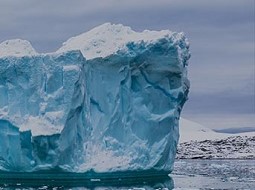
Northumbria's academics are studying the future of ice sheets and glaciers worldwide in a warming world. This involves understanding the causes of ongoing changes in Antarctica, Greenland and alpine areas, as well as assessing future changes and resulting impacts on human environments globally.
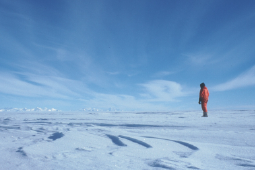
At Northumbria’s School of Geography and Natural Sciences, we are driven by one goal: protecting planetary health and building a more resilient future for both people and the natural world.
This is the place to find all the latest news releases, feature articles, expert comment, and video and audio clips from Northumbria University
Latest News and Features
From Netflix to Newcastle Northumbria graduate uses AI to revolutionise film and TV production
A Northumbria University graduate who co-created Bangkok Breaking — one of Thailand's biggest…

Northumbria University researcher brings death-positive arts festival to libraries across England
An arts festival exploring death, dying and end-of-life choices — led by a Northumbria University…
Northumbria University spinout achieves CE marking for deep lung breath sampling device — a first backed by peer-reviewed research
A medical device company spun out of Northumbria University has reached a significant milestone…

Northumbria University's IT recycling initiative recognised as national best practice
The equivalent weight of one and a half double-decker buses' worth of IT equipment has been…
Scientists solve decades-long mystery about why Saturn appears to change its spin
Researchers at Northumbria University have used the most powerful space telescope ever built…

Northumbria University professor named among UK's most outstanding health and care research leaders
A Northumbria University professor has been appointed as one of the UK's most influential health…
From campuses to communities: Newcastle's fifth Climate Change Forum forges greener future for city
Newcastle's fifth Climate Change Forum drew a full house – and an energising conversation about…

'Safer Stadiums' research shares women's experiences at men's football games
New research led by Northumbria University highlights the experiences of women who attend men's…
More events
Upcoming events

From sustenance to complete nourishment in a changing and uncertain climate
Ellison Building A, 001 (ELA 001)
-

Broken Bonds: New Perspectives on Marital Breakdown
The Great Hall
-

Smarter Supply Chains: Digital Innovation for Cost, Efficiency & Carbon
Northumbria University
-

Culture in Conversation: Rethinking Leadership & Organisational Practice
CCE1 Newcastle Business School
-
