
The North East Space Communications Accelerator (NESCA) has announced its second round of innovation funding, distributing almost £490,000 across 13 cutting-edge space communications and technology projects.
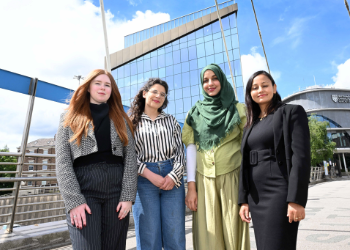 Five
of the successful projects are led by women – a fitting milestone in the week
marking 63 years since Soviet cosmonaut Valentina Tereshkova became the first
woman to travel to space.
Five
of the successful projects are led by women – a fitting milestone in the week
marking 63 years since Soviet cosmonaut Valentina Tereshkova became the first
woman to travel to space.
To this day she remains the only woman to have completed a solo space mission, and more than six decades on, the North East's growing space sector is demonstrating that the ambition she embodied is very much alive in the region's universities and research labs.
Of the 13 successful projects in NESCA's second round, five are led by women: Dr Amna Riaz and Dr Nassima Khorchef at Northumbria University, Dr Kabita Adhikari at Newcastle University, Dr Perrine Lognoné at Durham University, and Isabelle Crossley, a PhD researcher also at Durham.
The cohort builds on a strong foundation established in the first round of funding, which saw Dr Juna Sathian at Northumbria University awarded funding for her MASER-Link project, developing a new type of interference-free signal generator for satellite communications.
NESCA project lead Professor Vincent Barrioz, from Northumbria's School of Engineering, Physics and Mathematics, said: "Round 2 attracted an exceptional field of applications, and the breadth and technical quality made for genuinely difficult decisions.
“The 13 funded projects span everything from optical intersatellite links to crop surveillance and launch-vehicle communications, each underpinned by an industrial partnership.
“I'm particularly pleased that five are led by women, it's a powerful signal that the talent driving the North East's space sector is as diverse as it is ambitious.”
 Northumbria’s
Dr Amna Riaz has been awarded more than £64,000 funding for her
Gimbal-Stabilised Optical Communications project, which tackles one of the key
practical challenges in laser-based space communications – keeping a narrow
optical beam precisely locked on its target.
Northumbria’s
Dr Amna Riaz has been awarded more than £64,000 funding for her
Gimbal-Stabilised Optical Communications project, which tackles one of the key
practical challenges in laser-based space communications – keeping a narrow
optical beam precisely locked on its target.
Her solution uses a motorised mounting system that automatically adjusts the direction of a laser beam, keeping it precisely aimed even as the platforms carrying it move – whether that's a satellite, a drone, a vehicle, or a portable ground station.
In partnership with North East company OpenWorks Engineering, the project will culminate in a flight-ready prototype with clear commercial pathways across both space and defence markets.
Speaking about her research and successful funding, she said: “Growing up in Kashmir, space was not something women like me were supposed to reach for. Engineering was considered a male profession, and the space sector felt like it belonged to a different world entirely.
“But here I am. NESCA has given me something I could not have built alone – the funding, the industry partnership, and a clear pathway to take my research from a laboratory idea to a flight-ready prototype.
“Sixty-three years after Valentina Tereshkova proved that the sky was not the limit, women across the North East are doing the same thing – not with a single historic flight, but with research, funding, and the daily work of building something new.
“I hope this project shows the next generation of girls – especially those told, as I was, that this world is not for them – that it absolutely is.”
Fellow Northumbria academic Dr Nassima Khorchef, will work with regional industry partner Filtronic to design a hybrid communication system for CubeSat constellations. The technology will combine laser optical links with radio frequency backup, giving small satellite operators an affordable, industrially validated route to advanced intersatellite connectivity.
Dr Khorchef said: “Securing this funding marks a profound milestone in my career. I am deeply grateful to NESCA for their belief in our projects and their unwavering support for women in space.
“This is a signal that something larger is coming for the next generation of women in space. This investment is more than a financial catalyst; it is a partnership that empowers the North East region to reach new heights in space research and technology, drive innovation, and open a new chapter of growth between academia and industry that will echo far beyond this moment.”
 At
Durham University, Dr Perrine Lognoné is working with Telespazio UK to build a
first-of-its-kind testing facility. The project uses a 7km laser link on the
Durham campus to recreate the atmospheric interference that satellite signals
encounter in the real world, giving UK companies a way to test their technology
on the ground before it goes into space.
At
Durham University, Dr Perrine Lognoné is working with Telespazio UK to build a
first-of-its-kind testing facility. The project uses a 7km laser link on the
Durham campus to recreate the atmospheric interference that satellite signals
encounter in the real world, giving UK companies a way to test their technology
on the ground before it goes into space.
 Also
at Durham, Isabelle Crossley is working with Newton Aycliffe-based Viper RF to
develop a more reliable way of keeping in contact with small rockets during
flight. The project aims to produce a communications module that could be used
as a standard piece of kit for the next generation of UK and international
launch vehicles.
Also
at Durham, Isabelle Crossley is working with Newton Aycliffe-based Viper RF to
develop a more reliable way of keeping in contact with small rockets during
flight. The project aims to produce a communications module that could be used
as a standard piece of kit for the next generation of UK and international
launch vehicles.
 Meanwhile
at Newcastle University, Dr Kabita Adhikari is working with Craft Prospect to
tackle one of the biggest challenges facing UK farmers: crop disease and pest
damage, which can destroy up to 40% of a harvest. Her project fuses satellite
imagery, radar data, and Met Office weather information to monitor fields
continuously regardless of cloud cover, using a transparent AI system that can
flag threats in plain English – giving farm officers the chance to act before
yield is lost.
Meanwhile
at Newcastle University, Dr Kabita Adhikari is working with Craft Prospect to
tackle one of the biggest challenges facing UK farmers: crop disease and pest
damage, which can destroy up to 40% of a harvest. Her project fuses satellite
imagery, radar data, and Met Office weather information to monitor fields
continuously regardless of cloud cover, using a transparent AI system that can
flag threats in plain English – giving farm officers the chance to act before
yield is lost.
The second round of NESCA funding distributes almost £490,000 across 13 projects spanning the programme's five research themes: Technologies; Smart and Resilient Networks; In Space Opportunities; Space Sustainability; and Terrestrial Applications.
Projects range from launch-pad grants supporting early-stage feasibility work, to larger lift-off grants enabling prototype development and industry engagement over longer timescales.
The full list of funded projects is:
Northumbria University:
- 3D carbon electrodes with conformal nickel–transition metal functional coatings for space-based electrolysis systems – Mike Taverne, with Exotopic Limited
- Intelligent Infrared Sensing Module for Space Application – Dr Jiguang Li, with MConnected Ltd
- Hybrid RF and Optical Communication Systems for Intersatellite Links – Dr Nassima Khorchef, with Filtronic plc
- Gimbal-Stabilised Optical Communications for Multi-Domain Applications – Dr Amna Riaz, with OpenWorks Engineering
- Epoxy-amine-boron polymer composites for enhanced radiation shielding, heat management and flexibility of design – Matthew Unthank, with Boyd Technologies Ashington UK Ltd
- SLIPT-X: Simultaneous Lightwave Information and Power Transfer for Secure Remote Sensing with Drone Activation and Satellite Backhaul – Dr Abderrahmen Trichili, with Connexin Limited (joint project with Newcastle University)
- Multi-Lander Communication Framework for JAXA's 2031 Mars Exploration Mission Step-1 – Professor Javier Martin-Torres, with AVS Added Value Solutions UK Ltd
Newcastle University:
- Explainable Digital Twin Crop Surveillance Using Multi-Source Satellite, Radar and Weather Data – Dr Kabita Adhikari, with Craft Prospect Ltd
- IRIS — InfraRed Intelligent Surfaces – Dr Toby Hallam
- AutoCube – Feasibility Study of Autonomic Computing for Next-Generation Micro-Satellites – Dr Tomasz Szydlo, with Craft Prospect Ltd
Durham University:
- Development of a bidirectional ground-space optical link emulator for telecom systems turbulence resilience qualification – Dr Perrine Lognoné, with Telespazio UK Ltd
- SpaceWatch: Deployable Ground-based Sensors for Detection, Tracking and Characterisation of Space Objects – Professor Hubert Shum, with OpenWorks Engineering
- Reliable Communications to Small Launch Vehicles – Isabelle Crossley, with Viper RF
As with the first round of funding, all projects include industrial partnerships, and several are led by Early Career Researchers, reflecting NESCA's commitment to developing regional talent and building the next generation of space sector leaders.
NESCA is a £2.6 million, four-year programme funded by the Engineering and Physical Sciences Research Council (EPSRC), bringing together Northumbria, Durham, and Newcastle universities alongside the North East Combined Authority, Space North East England, the North East Space Leadership Group, and 14 industry partners.
Further funding rounds will be announced throughout the programme. NESCA encourages applications from the three partner universities, as well as from national industry partners and Higher Education institutions outside the region looking to collaborate with the three partner universities and the North East's growing space cluster.
For more information about NESCA and future funding opportunities, email nesca@northumbria.ac.uk or visit www.northumbria.ac.uk/nesca
NESCA is funded by EPSRC, grant no EP/Z536301/1.

North East Space Communications Accelerator is a £2.5M EPSRC funded initiative advancing resilient space communications.

Northumbria University is powering the next generation of space innovation. Learn more about our expert academics, world class research and state of the art facilities.

Our North East Space Skills and Technology Centre will be a state of the art £50M facility developed by Northumbria, with investment from the UK Space Agency and the space and satellite division of industry giant Lockheed Martin.

At Northumbria Engineering, Physics and Mathematics are co-located in one ambitious, future-facing school.
Latest News and Features

UK network to accelerate the development of sustainable surface technologies
A new national network led by Newcastle University and Northumbria University, in partnership…

Criminologist wins acclaimed Philip Leverhulme Prize to pioneer a new criminology of the offshore world
A Northumbria University criminologist has been awarded a Philip Leverhulme Prize, one of the…
New platform maps charity support for the Armed Forces community
Pioneering data platform maps where the Armed Forces community receive support from charities

Northumbria co-leads study on fairer support for families
A major study co-led by Northumbria University will test whether attachment assessments lead…

New AHRC research shows how community innovation can power the next phase of devolution.
New research published today by the AHRC Creative Communities programme provides fresh evidence…

Free sessions to help families navigate the SEND system
Northumbria University's award-winning Student Law Office is launching SEND Decoded, a series…

New Doctoral Training Programme will tackle key polar science questions with a reduced carbon footprint
The Net Zero Polar Science (NZPS) Doctoral Training Programme (DTP) has welcomed its first…

New Student Health Hub brings joint health and wellbeing support
A new drop-in service is bringing health and wellbeing support for students at both Newcastle…
More events
Upcoming events

Next Stop Northumbria
Manchester Marriott Hotel Piccadilly
-

-
Magnetospheric Multiscale Science Working Team Meeting
Sutherland Building

Christmas Market and Tree lighting
Northumbria University
-
