
The Legal and Professional Skills (LEAPS) group focuses on how to integrate research into academic learning and legal practice. The group is an inclusive collegiate group that provides support to promote and enhance legal education at Northumbria and beyond based on its pioneering research. The group builds on the work of the Clinical Legal Education Research group and acts as a focus point for activity. A varied programme of support for conference attendance, writing retreats and collaboration have created an innovative environment and a strong platform for growth.
LEAPS is committed to informing and contributing to developments in teaching and learning in the Law School and, in particular, to fostering a research-rich teaching and learning environment for students and staff alike. The Law School's existing clinical programmes regularly involve students engaging in experiential learning in the community and its focus on enquiry-based learning methods enables the group’s research to both draw on, and contribute to, new innovative learning initiatives.
There is a well-established history of research into clinical legal education in the Law School which publishes the International Journal of Clinical Legal Education and hosts an annual international conference. Members of LEAPS are on editorial boards of legal education journals, hold prestigious legal education roles with key external stakeholders and are regularly quoted in the mainstream news in relation to legal education matters.
Research Highlights
Research carried out by LEAPS has had a significant impact and has influenced the Higher Education sector. In 2019, Professor Chris Ashford carried out the QAA Law benchmark Statement which defines the academic standards that can be expected of UK law graduates.
Funding success has driven high-quality research events and outputs. For example, Northumbria hosted an international seminar funded by the Modern Law Review, ‘Revisiting Pressing Problems in the Law: What is the Law School For?’ and a project in collaboration with Cumbria University explored the evolving technological trends in legal practice.
In 2018, researchers led the Family Justice Project which worked with a BAME women’s organisation to provide free community legal support. The project was awarded ‘best pro bono activity’ at the LawWorks and Attorney General Student Awards 2018.
This international journal is hosted and edited by members of LEAPS. There is full open access to current and archive articles. View the latest issue
You can follow the IJCLE on twitter: @ijcle
The group organises an Annual International Journal of Clinical Legal Education Conference which partners with global organisations and law schools around the world for researchers to share their work and build new collaborations and partnerships.
Previous locations for the conference have included:
Comenius University, Slovakia, 2019
Monash University, Australia, 2018
Toronto University, Canada, 2016
18 January 2021
Northumbria Law lecturer appointed Chair of Law Society's Education and Training Committee. Read the news article
LEAPS members speak at Legal Education and Training Review conference
25 June 2018
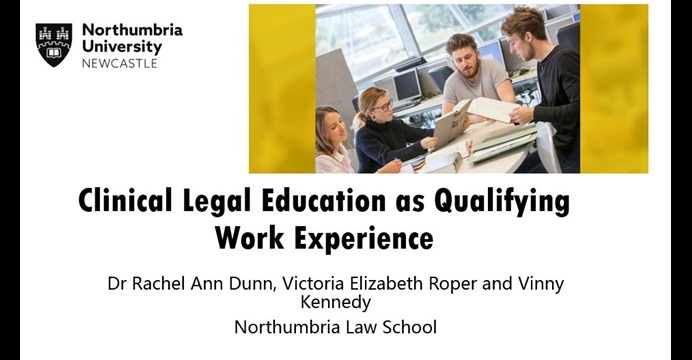
Rachel Dunn, Victoria Roper, and Vinny Kennedy delivered a paper entitled “'Clinical Legal Education as Qualifying Work Experience”, at the LETR 5 Years On Conference in Leeds on 25 June 2018. Rachel, Victoria, and Vinny considered the challenges law schools may face if they choose to engage in clinical legal education as Qualifying Work Experience, and the practical considerations to be borne in mind if law schools decide the certify that the student has had the opportunity to develop the solicitor competences. You can access the slides here.

Exploring and Understanding the Evolving Technological Trends in Legal Practice in order to Identify and Address any Gaps in Legal Education
Northumbria University and the University of Cumbria are researching the use of technology in legal education and practice. This collaborative research project, funded by BILETA, explores how law schools are addressing the increasing needs and expectations of legal practice in supporting and preparing students for ‘digital lawyering’. The primary research activity will involve gathering, and analysing, data from interviews with law firms and organisations in England and Wales.
If you would like to support and/or participate in this research project, or if you would like further information, please contact the project’s co-investigators:
| Miss. Ann Thanaraj | Dr. Craig Laverick |
|
Principal Lecturer & Head of School |
Senior Lecturer |
| University of Cumbria | Northumbria University |
| Email: ann.thanaraj@cumbria.ac.uk |
To download the Participant Information sheet please click here
To download the Questionnaire please click here or to view it online please visit https://northumbria.onlinesurveys.ac.uk/legaltech

Our Publications
Members of LEAPS serve on editorial boards of a number of legal education journals, maintain strong links with professional legal networks and contribute greatly to a wide range of legal education discourse. A selection of recent publications can be found here:
Tribe Mkwebu (2020) Research on Clinical Legal Education: Unpacking the Evidence. The Clinical Legal Education Handbook. Thomas, L. & Johnson, N. (eds.). Institute of Advanced Legal Studies
Rachel Dunn (2020) Diamonds are a girl’s best friend… and a great data collection tool! International Journal of Clinical Legal Education, 27(3), p. 33-76
Lyndsey Bengtsson, Rachel Dunn & Siobhan McConnell (2020) The Policy Clinic at Northumbria University: Influencing Policy/Law Reform as an Effective Educational Tool for Students. International Journal of Clinical Legal Education, 27(2) p. 68-102
Victoria Roper, Rachel Dunn & Samantha Rasiah (2020) Revisiting “Pressing problems in the law: what is the law school for?” 20 years on. The Law Teacher, 54, 3, p. 455-464
Callum Thomson, Lyndsey Bengtsson & Tribe Mkwebu (2019) The Hall of Mirrors: a teaching team talking about talking about reflection. The Law Teacher, 53(4), p. 513-523
Kayliegh Richardson & Ana Speed (2019) Promoting Gender Justice within the Clinical Curriculum: evaluating student participation in the 16 Days of Activism Against Gender-Based Violence campaign. International Journal of Clinical Legal Education, 26(1), p. 87-131
Victoria Roper, Rachel Dunn & Vinny Kennedy (2019) Clinical Legal Education as Solicitor Qualifying Work Experience, The Clinical Legal Education Handbook, Institute of Advanced Legal Studies
Elaine Hall, J Hodgson, C Strevens & J Guth (2019) "What we did over the summer": updates on proposed reforms to legal education and training in England and Wales and in the Republic of Ireland, Law Teacher, 53 (4), p. 536-546
Rachel Dunn & Richard Glancey (2019) Using legal policy and law reform as assessment, Critical Perspectives on the Scholarship of Assessment and Learning in Law: Volume 1: England. Bone, A. & Maharg, P. (eds.). Canberra: Australian National University Press, p. 139-163 (Assessment in Legal Education).
Elaine Hall (2019) Grasping the nettle of ‘doctorateness’ for practitioner academics: a framework for thinking critically about curriculum design. Studies in Continuing Education, 41, 2, p. 157-172
Hall, Elaine (2018) Glass Houses: how might we decide on a ‘good enough’ assessment to become a solicitor? The Law Teacher, 52(4) pp. 453-466
Dunn Rachel, Roper Victoria & Kennedy Vinny (2018) Clinical Legal Education as Qualifying Work Experience for Solicitors, The Law Teacher, 52(4) pp. 439-452.
Roper, Victoria (2018) Blogs as a Teaching Tool and Method of Public Legal Education: A Case Study, International Journal of Public Legal Education, 2(1) pp. 46-70.
McKeown, Paul & Hall, Elaine (2018) If we could instil social justice values through clinical legal education, should we?, Journal of International and Comparative Law, 5(1) pp. 143-180.
Roper, Victoria (2018) Round Up of the 2nd Commercial Law Clinics Round Table – 9th March 2018, International Journal of Clinical Legal Education, 25(2) pp. 248-262.
Sylvester, Cath & Hall, Elaine (2018) Clinic as the crucible for theorised practice and the practice of theory in legal education, Reimagining Clinical Legal Education, Bloomsbury Publishing.
Roper, Victoria, Campbell Elaine, Ben-David, Assaf, Greenbaum, Dov and Askin, Jonathan. Understanding the Scope of Business Law Clinics: Perspectives from the United Kingdom, Israel and the United States, Journal of International and Comparative Law, 5(1) pp. 217-257.
Roper, Victoria (2018) Blogs as a Teaching Tool and Method of Public Legal Education: A Case Study, International Journal of Public Legal Education, 2(1) pp. 46-70.
McKeown, Paul (2018) Can Social Justice Values be Taught Through Clinical Legal Education?, Social Justice and Legal Education, Cambridge Scholars, pp. 84-110.
Campbell, Elaine (2018) Taking Care of Business: Challenging the Traditional Conceptualization of Social Justice in Clinical Legal Education, Social Justice and Legal Education, Cambridge Scholars, pp. 168-84.
Hall, Elaine (2017) Notes on the SRA report of the consultation on the SQE: Comment is free, but facts are sacred, The Law Teacher, 51(3) pp. 364-372.
Dunn, Rachel (2017) A systematic review of the literature in Europe relating to clinical legal education, International Journal of Clinical Legal Education, 24(2) pp. 81-117.
Mkwebu, Tribe (2017) Unpacking Clinical Scholarship: Why Clinics Start and How They Last, Asian Journal of Legal Education, 4(1) pp. 33-46.
McKeown, Paul (2017) Pro bono: what's in it for law students? The students' perspective, International Journal of Clinical Legal Education, 24(2) pp. 43-80.
Campbell, Elaine & Boothby, Carol (2016) University law clinics as alternative business structures: more questions than answers?, The Law Teacher, 50(1) pp. 132-137.
Campbell, Elaine (2016) Recognizing the Social and Economic Value of Transactional Law Clinics: A View from the United Kingdom, Journal of Legal Education, 65(3) pp. 580-596.
Boothby, Carol (2016) ‘Pigs are not fattened by being weighed’ – so why assess clinic- and can we defend our methods?, International Journal of Clinical Legal Education, 23(1) pp. 137-155.
Campbell, Elaine (2016) Exploring Autoethnography as a Method and Methodology in Legal Education Research, Asian Journal of Legal Education, 3(1) pp. 95-105.
Murray, Victoria (2016) Developing Clinic, The Legal Academics Handbook, Palgrave Macmillan.
Sylvester, Cath (2016) Through a glass darkly: Assessment of a real client, compulsory clinic in an undergraduate law programme, International Journal of Clinical Legal Education, 23(1) pp. 32-47.
Ashford, Chris (2016) Response: The needs of the legal profession and the liberal law school: (Re)negotiating boundaries, Perspectives on Legal Education: Contemporary Responses to the Lord Upjohn Lectures, Taylor & Francis, pp. 177-187.
Dunn, Rachel (2016) The Taxonomy of Clinics: The Realities and Risks of All Forms of Clinical Legal Education, Asian Journal of Legal Education, 3(2) pp.174-187.
McKeown, Paul & Morse, Sarah (2016) Further Developing Street Law, The Legal Academic's Handbook, Palgrave Macmillan, pp. 84-86.
Mkwebu, Tribe (2016) Unpacking Clinical Scholarship: Why Clinics Start and How They Last, Asian Journal of Legal Education, 4(1) pp.33-46.
Ashford, Chris, Duncan, Nigel & Guth, Jessica (2015) Perspectives on Legal Education: Contemporary Responses to the Lord Upjohn Lectures, Taylor & Francis.
Boothby Carol & Sylvester, Cath (2015): Getting the fish to see the water: an investigation into students’ perceptions of learning writing skills in academic modules and in a final year real client legal clinic module, The Law Teacher, 51(2) pp. 123-137.
Campbell, Elaine & Murray, Victoria (2015) Mind the Gap: Clinic and the Access to Justice Dilemma, International Journal of Legal and Social Studies, 2(3) pp. 94-106.
Campbell, Elaine (2015) Students as facilitators: an evaluation of student-led group work, Practitioner Research in Higher Education, 9(1) pp. 52-58.
Campbell, Elaine (2015) A dangerous method? Defending the rise of business law clinics in the UK, The Law Teacher, 49(2) pp.165-75.
Campbell, Elaine (2015) Transferring Power: a reflective exploration of authentic student-centred small group work in clinical legal education, International Journal of Clinical Legal Education, 22(2) pp.181-212
Gleason, Victoria & Campbell, Elaine (2015) Cultivating 21st century law graduates through creativity in the curriculum, Journal of Commonwealth Law and Legal Education, 10(1) pp. 4-20.
McKeown, Paul (2015) Law student attitudes towards pro bono and voluntary work: The experience at Northumbria University, International Journal of Clinical Legal Education, 22 (1) pp. 6-46.
McKeown, Paul & Dunn Rachel (2015) The European Network of Clinical Legal Education: The Spring Workshop 2015, International Journal of Clinical Legal Education, 22(3) pp. 312-333.
McKeown, Paul & Morse,Sarah (2015) Litigants in person: is there a role for higher education?, The Law Teacher, 49(1) pp. 122-129.
Mkwebu, Tribe (2015) A Systematic Review of Literature on Clinical Legal Education: A Tool for Researchers in Responding to an Explosion of Clinical Scholarship, International Journal of Clinical Legal Education, 22(3) pp. 238-274.
Sandford-Couch, Clare & Bainbridge, Jonathan (2015) Educating towards ethical lawyers: a progress report, The Law Teacher, 49(3) pp. 336-352.
Sylvester, Cath (2015) Measuring competence in legal education: a view from the bridge, The Law Teacher, 49(2) pp. 1-15.
Sylvester, Cath (2015) More questions than answers? A review of the effectiveness of inquiry based learning in higher education, The Journal of Commonwealth Law and Legal Education, 10(1) pp. 21-29.
2019 International Seminar: Revisiting “Pressing Problems in the Law: What is the Law School for?” 20 Years On
This seminar was held on 17th June 2019, at Northumbria Law School. The seminar was kindly funded by the Modern Law Review and was a joint project by Northumbria’s Legal Education and Professional Skills Research Group (LEAPS) and Nottingham Law School’s Centre for Legal Education (CLE). It was well-attended with over 60 delegates, representing over 30 Institutions from the UK, Australia and Canada. The seminar also stimulated substantial engagement and coverage on online platforms. The seminar hashtag #20yrson was used 320 times on the day of the seminar, with a potential reach of up to 73,102 unique users on Twitter. Professor Paul Maharg, from Osgoode Hall Law School, Canada also live blogged the seminar at paulmaharg.com on the day.
2016 Association of Law Teachers Annual Conference: Promoting Collaboration
Northumbria University is proud to be hosting the 51st Annual Conference of the Association of Law Teachers from the 20th – 22nd March 2016 in Newcastle. This promises to be a great event with the conference dinners to be at the Baltic Centre for contemporary Art and the Sage Gateshead. Two of the most beautiful and iconic buildings in the North East with magnificent views of the Tyne. The conference hotel is the Jurys Inn, NewcastleGateshead Quays. Accommodation this year is to be booked separately from the conference itself but you can use this link.
The overall theme of the conference is Promoting Collaboration. It will examine the ways in which legal educators and trainers can work together and will explore collaborative links between legal education and the legal profession, law students, other professions and the community (amongst others). The conference will be organised around a series of strands which will include, but are not restricted to:
1. Collaboration with the legal profession and providers of legal services
2. Interdisciplinary, international or non-legal professional collaborations
3. Collaboration with the community (recipients of legal services) or students (recipients of legal education)
4. Facilitating collaboration through technology
5. Sharing good practice in legal education and training and collaborative research projects
Claire Palley, the U.K.’s First Woman Law Professor: Learning from an Academic Life
18th June 2015
Professor Fiona Cownie, (Keele University): Claire Palley, the U.K.’s First Woman Law Professor: Learning from an Academic Life.
Many of you will know Fiona who has written on a wide range of legal education issues and is now Pro Vice Chancellor for education and student experience at Keele University. This talk draws on biographical interviews with Claire Palley, the first woman to be appointed to a Chair in Law in the U.K, this paper is part of an extended project exploring the legal biographies of early women law professors.
Problematising Assessment in Clinical Legal Education
4th June 2015
The Law Teacher and ALT Seminar
Problematising Assessment in Clinical Legal Education
This is an interactive seminar and discussion forum centred on a one day conference exploring the theme of how experiential learning in law is assessed. The international move towards an increasingly outcomes based approach to legal education and training has raised the profile and encouraged the development of a wide range of experiential learning practices in legal education. The extent to which these practices evidence the multiple and complex competencies they lay claim to is now attracting scrutiny. The challenge of how to assess and what to assess in work integrated learning, problem and enquiry based learning, clinical legal education and simulated leaning is emerging as an important and developing issue. The subject is particularly relevant to providers of legal education and training in England and Wales following the SRA’s announcement that it will be consulting on assessment in relation to the threshold outcomes in 2015.
Legal Education, Social Mobility and Employability: Possible Selves, Curriculum Intervention, the role of Legal Work Experience and the Challenge for Clinics
13th May 2015
Professor Andrew Francis (Head of School, Keele University): Legal Education, Social Mobility and Employability: Possible Selves, Curriculum Intervention, the role of Legal Work Experience and the Challenge for Clinics.
Andrew has carried out a lot of empirical research into legal education, social mobility and employability over the years including looking at how legal work experience affects employability. This seminar builds on his forthcoming article in the Journal of Law and Society (2015) 42(2), draws on recent empirical data on the experiences and process of legal work experience to critique taken for granted assumptions of employability. In this discussion, he builds on this paper to consider the challenges and opportunities for clinical legal education in the light of these lessons.
Research, Learning and Practice
LEAPS is committed to informing and contributing to developments in teaching and learning in the School of Law at Northumbria and in particular to foster a research rich teaching and learning environment for students and staff alike. The School's existing clinical programmes which regularly involve students in legal practice in the community and its commitment to enquiry based learning methods enables the group to both draw on and contribute to new teaching and learning initiatives in its research.
Latest News and Features
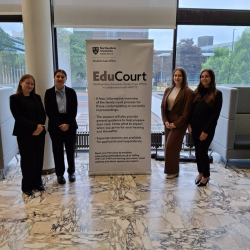
Student Law Office partnership with HMCTS provides invaluable real-world training while supporting individuals through the family courts
Northumbria University law graduates highlight the transformative impact of EduCourt, an innovative…

Northumbria Law School Professor Advises UK Government on India-UK Trade Agreement
Professor Gita Gill of Northumbria Law School has been invited to provide expert advice to…

Northumbria University hosts landmark UK AI Research Symposium
Northumbria University has been selected to host the inaugural UK AI Research Symposium (UKAIRS)…

Northumbria expands results day support for students
Northumbria University is expanding and enhancing the support it provides to students receiving…

Northumbria University leads major study to tackle NHS fraud
Northumbria University is spearheading vital research to enhance counter-fraud strategies within…

Northumbria wins recognition for expanding access to higher education
Northumbria University has been named Higher Education Institution of the Year at a prestigious…
More events
Upcoming events

Archives to Action: Historical Evidence for Policy Reform
Virtual Workshop
-

Commercialising SHAPE Innovations and Impact
Northumbria University
-
Broken Bonds: New Perspectives on Marital Breakdown
The Great Hall
-
